Showing posts with label Space. Show all posts
Showing posts with label Space. Show all posts
Wednesday, January 02, 2013
2013's First Meteor Shower
For people who are interested in meteor showers :
http://www.nasa.gov/topics/solarsystem/features/watchtheskies/quadrantids_2013.html


Sunday, September 09, 2012
Voyager 1 turns 35, approaches interstellar space...
The craft — one of twin spacecraft (Voyager I & II) sent to explore distant planets — is approaching interstellar space. The primary mission for these satellites was the exploration of Jupiter and Saturn. After making a string of discoveries there -- such as active volcanoes on Jupiter's moon Io and intricacies of Saturn's rings -- the mission was extended. Voyager 2 went on to explore Uranus and Neptune, and is still the only spacecraft to have visited those outer planets. The adventurers' current mission, the Voyager Interstellar Mission (VIM), will explore the outermost edge of the Sun's domain. And beyond. Interstellar Mission searches for the heliopause — the border between the magnetic influence of the sun and the beginning of interstellar space — and exits the solar system.
Below is an image of Voyager I
 Below is the image of Voyagers and other satellites nearing Heliopause
 Voyager 1 is poised to cross into interstellar space. Both Voyager 1 and 2 are expected to continue to provide critical data for another decade, if not longer — or at least until their energy supplies can no longer power critical subsystems. The mission objective of the Voyager Interstellar Mission (VIM) is to extend the NASA exploration of the solar system beyond the neighborhood of the outer planets to the outer limits of the Sun's sphere of influence, and possibly beyond. This extended mission is continuing to characterize the outer solar system environment and search for the heliopause boundary, the outer limits of the Sun's magnetic field and outward flow of the solar wind. Penetration of the heliopause boundary between the solar wind and the interstellar medium will allow measurements to be made of the interstellar fields, particles and waves unaffected by the solar wind.
 The twin Voyager 1 and 2 spacecraft continue exploring where nothing from Earth has flown before. In the 34th year after their 1977 launches, they each are much farther away from Earth and the Sun than Pluto. Voyager 1 and 2 are now in the "Heliosheath" - the outermost layer of the heliosphere where the solar wind is slowed by the pressure of interstellar gas. Both spacecraft are still sending scientific information about their surroundings through the Deep Space Network (DSN)
 This artist’s rendering provided by NASA is of the Voyager 1 spacecraft, which was launched 35 years ago Wednesday. (Its twin spacecraft, Voyager 2, was launched Aug. 20, 1977.) Cameras aboard the Voyagers were turned off long ago. The nuclear-powered spacecraft, about the size of a subcompact car, still have five instruments to study magnetic fields, cosmic rays and charged particles from the sun known as solar wind. They also carry gold-plated discs containing multilingual greetings, music and pictures — in the off chance that intelligent species come across them.

Courtesy: Washington Post, Voyager NASA website
Below is an image of Voyager I


| TIMELINES | |
| DATE | MILESTONE |
| 1977 | Mariner Jupiter/Saturn 1977 is renamed Voyager |
| 1977 Aug.20 | Voyager 2 launched from Kennedy Space Flight Center |
| 1977 Sept.5 | Voyager 1 launched from Kennedy Space Flight Center Voyager 1 returns first spacecraft photo of Earth and Moon |
| 1979 Mar.5 | Voyager 1 makes its closest approach to Jupiter |
| 1979 July.9 | Voyager 2 makes its closest approach to Jupiter |
| 1980 Nov.12 | Voyager 1 flies by Saturn Voyager 1 begins its trip out of the Solar System |
| 1981 Aug.25 | Voyager 2 flies by Saturn |
| 1982 | Deep Space Network upgrades two 26-m antennas to 34-m |
| 1986 Jan.24 | Voyager 2 has the first-ever encounter with Uranus Deep Space Network begins expansion of 64-m antennas to 70-m |
| 1987 | Voyager 2 "observes" Supernova 1987A |
| 1988 | Voyager 2 returns first color images of Neptune |
| 1989 Aug.25 | Voyager 2 is the first spacecraft to observe Neptune Voyager 2 begins its trip out of the Solar System, below the ecliptic plane |
| 1990 Jan.1 | Begins Voyager Interstellar Mission |
| 1990 Feb.14 | Last Voyager Images - Portrait of the Solar System |
| 1998 Feb.17 | Voyager 1 passes Pioneer 10 to become the most distant human-made object in space |
| 2004 Dec.15 | Voyager 1 crosses Termination Shock |
| 2007 Sep.5 | Voyager 2 crosses Termination Shock |
| 2012 Sep.9 | Voyager enters Interstellar Space |
Monday, August 06, 2012
NASA's CURIOSITY rover lands safely on Mars
After a 352 million mile journey NASA's latest rover - CURIOSITY - landed safely on Mars on 5-AUG-2012. The rover did experience a harrowing plunge, as expected, through the planet’s atmosphere dubbed “7 Minutes of Terror.”

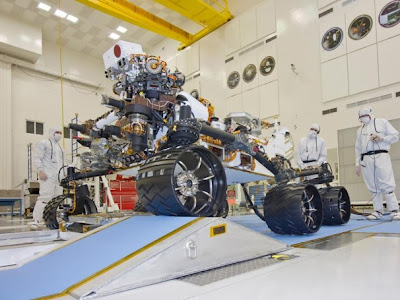

Amazing Video(s) here:
CURIOSITY - LANDING:

CURIOSITY - REAL:
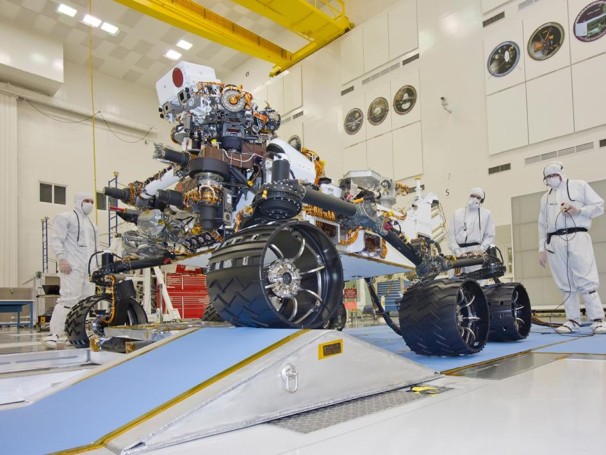
CURIOSITY - CARTOON:

More Images here: Click here for more Images
Courtesy: Washington PostMonday, September 25, 2006
Face on Mars
 NASA started it all back in 1976 with an image of an interesting mountain on Mars and a caption that described it as appearing to have eyes and nostrils.
The feature known as the Face, along another skull-like feature and pyramid-looking hills in the vicinity, are in an area called Cydonia in the Arabia Terra region.
It is a transition zone between the southern highlands and the northern plains, and it contains wide valleys and ancient remnant mounds, called massifs, of many shapes and sizes. The massif that became the infamous "Face" was first seen in a photo taken on July 25, 1976 by NASA's Viking 1 Orbiter.
Thirty years later, the "Face on Mars" still inspires myths and conspiracy theories.
New images from the European Space Agency's Mars Express orbiter will confirm for many that the features are natural, while no doubt offering tantalizing "clues" to others of an ancient intelligent civilization at work.
 The spacecraft's High Resolution Stereo Camera provides data the researchers turn into color perspective views, which simulate the scene as though you were flying high over the region in an aircraft.
NASA scientists thought it looked like a human head, and although they knew it was just an illusion, the agency's Jet Propulsion Laboratory issued this caption:
"The speckled appearance of the image is due to missing data, called bit errors, caused by problems in transmission of the photographic data from Mars to Earth. Bit errors comprise part of one of the 'eyes' and 'nostrils' on the eroded rock that resembles a human face near the center of the image. Shadows in the rock formation give the illusion of a nose and mouth. Planetary geologists attribute the origin of the formation to purely natural processes."
LATEST INFORMATION
Other photographs of the Face taken more recently show that from different angles, it does not look much like a face.
ESA scientists are interested in the geology of the region. Landslides and broad debris aprons show how the heavily eroded surface has changed over time, helping them piece together the real Martian past.
Friday, September 08, 2006
If we destroy our planet will science find a new one?
 Scientists are exploiting one of Einstein's predictions to find Earth-like planets around other stars -- planets that might even support Earth-like life. Let the evacuation plans begin!
WHAT
A way to spot Earth-size planets orbiting distant stars. Traditional techniques can't find small, rocky planets. But a new strategy called gravitational micro-lensing uses the bending of light to detect those elusive ersatz Earths. With it, astronomers have already found four new planets.
WHY
To determine whether we are alone in the universe. We're much more likely to find life on a rocky planet than on a gas giant like Jupiter -- and if the human race needs to find a new home in the future, rocky exosolar planets will probably be our destination. Also, some scientists theorize that small, solid planets outnumber gas giants (10:1 is a conservative estimate), but until now they couldn't test that hypothesis.
WHERE
All across the globe. A loose network of astronomers point their telescopes at the center of our galaxy, where they can see many stars at once. Because gravitational-microlensing events happen over the course of 10 to 40 days, research teams on different continents record data as dawn -- and the end of viable observation time -- approaches for their cohorts.
WHO
Two international teams of scientists, based in Chile and New Zealand and assisted by hundreds of volunteer astronomers, look for microlensing events across huge swaths of sky. They alert each other of probable events by Web and e-mail.
How many planets have been found?
Around 200. Most have been spotted by looking for wobbles in a star's motion that are caused by the gravitational attraction of a planet. But since this method preferentially finds huge planets that orbit close to their suns, it's turned up mostly "hot Jupiters."
Can I help in the Planet search?
ABSOLUTELY!... if you live south of 35 degrees north latitude (Memphis, Tennessee) and own a telescope with a 10-inch aperture equipped with a CCD detector. Readers interested in joining the effort should contact Andrew Gould at gould@astronomy.ohio-state.edu.
Tuesday, September 05, 2006
Europe's spacecraft hits the moon
 Image provided by the Canada-France-Hawaii Telescope Corp shows the impact of Europe's first spacecraft to the moon. Europe's first spacecraft to the moon ended its three-year mission Sunday by crashing into the lunar surface in a volcanic plain called the Lake of Excellence, to a round of applause in the mission control room in Germany.
Hitting at 2 kilometers per second(!!!) , the impact of the SMART-1 spacecraft was expected to leave a 3-meter-by-10-meter crater and send dust kilometers above the surface.
Launched into Earth's orbit by an Ariane-5 booster rocket from Kourou, French Guiana, in September 2003, SMART-1 used its ion engine to slowly raise its orbit over 14 months until the moon's gravity grabbed it.
SMART-1, a cube measuring roughly a meter on each side, took the long way to the moon -- more than 100 million kilometers instead of the direct route of 350,000 to 400,000 kilometers.
But the European Space Agency did it for a relatively cheap €110 million ($140 million).
The spacecraft has also been taking high-resolution pictures of the surface with a miniaturized camera.
PS
Talk About Smart People...
Thursday, August 24, 2006
Pluto no longer a planet!
Kids...get ready to update yourself...for what we learned in our third grade...that there are 9 planets in the solar system ...
Leading astronomers declared on AUG-24-2006 that Pluto is no longer a planet under historic new guidelines that downsize the solar system from nine planets to eight!
Members of the 6th General Assembly of International Astronomic Union vote on a resolution for planet definition in Prague.

Now there is a 12-planet solar system with eight classical planets and three bodies including Pluto in a new and growing category called "plutons" - Pluto-like objects - plus a former asteroid, Ceres collectively called "Dwarf Planets"
NASA's Hubble Space Telescope captured Pluto and its moon Charon in this image.
 After a tumultuous week of clashing over the essence of the cosmos, the International Astronomical Union stripped Pluto of the planetary status it has held since its discovery in 1930.
Textbooks and classroom materials will now have to be reworked, even as some aspects of the new decision are still being worked through.
Pluto has been demoted to a class of objects that has not yet been named. They would include celestial bodies orbiting a star that are large enough to pull themselves into a round shape but not large enough to clear their orbital paths of other objects. Pluto's orbit is largely decided by the much larger Neptune, which is what disqualifies it from being a planet.
Somewhat confusingly, both Pluto and 2003 UB313 will also be part of a larger group of objects known as dwarf planets. Dozens of objects will be part of this new group, which will be distinguished from the new, unnamed category of objects because dwarf planets are scattered more widely around the solar system. Ceres, for instance, which is between Mars and Jupiter and has long been thought to be an asteroid, will be considered a dwarf planet.
Now UB313 is the largest dwarf planet...doesnt it sound cool ;-)
Tuesday, August 22, 2006
Scientists Offer Proof of 'Dark Matter'
This composite image depicts the "bullet cluster" formed by galactic collision, with hot gas in a bullet shape shown in red and areas of dense matter in blue. Most of the matter in blue area is "dark," according to the astronomers' analysis
For decades, many scientists have theorized that the universe is made up of nearly undetectable mysterious substances called dark matter and dark energy. But until yesterday (22-aug-2006) there was no proof that the subatomic matter actually exists.
After studying data from a long-ago collision of two giant clusters of galaxies, researchers now say they are certain dark matter does exist and plays a central role in creating and defining gravity throughout the universe.
While the scientists are still not sure exactly what dark matter is, since they have yet to identify it in a laboratory, they said that the workings of the universe cannot be explained without it.
The breakthrough came using data from NASA's orbiting Chandra X-Ray Observatory and involved information from what researchers called the most massive release of detected energy in the universe since the big bang.
Scientists said that the "bullet cluster," formed by a collision between an enormous cluster of galaxies more than 3 billion light-years away and a smaller galaxy cluster, demonstrated the existence of dark matter. In effect, the collision stripped the dark matter away from visible matter. Once stripped, dark matter was clearly identified by the strong gravitational pull that it exerted.
The super-hot gases have qualities that typically would have become the seat of any new gravitational fields, cosmologists say, but instead they went with the stars. That could happen, Maxim Markevitch (Team member, Harvard-Smithsonian Center for Astrophysics in Cambridge, Mass., ) said, only if dark matter separated from the gases and collected with the stars.
Wireless robots may float above the Earth!
 Former NASA manager Bob Jones has a lofty idea for improving communications around the world: Strategically float robotic airships above the Earth as an alternative to unsightly telecom towers on the ground and expensive satellites in space.
He envisions a fleet of unmanned "Stratellites" hovering in the atmosphere and blanketing large swaths of territory with wireless access for high-speed data and voice communications.
Tethered flights of a prototype -- which cost about $3 million to build and is about one-fifth scale model of the planned commercial airships -- are scheduled later this month in this Mojave Desert city, about an hour's drive north of Los Angeles.
Unlike the cylindrical shape of a traditional blimp, a Stratellite has a broad, tapered nose like a shark. The solar-powered dirigible will carry a payload of radio and digital devices.
Cell towers are hampered by line-of-sight limitations and limited range. Geostationary satellites suffer from the quarter-second it takes a signal to travel out 22,300 miles and back -- insignificant in one-way TV transmissions, but terrible for two-way Internet computer communications.
Jones believes his solar-powered, helium-filled Stratellites _ so named because they would hang in the stratosphere -- could replace unsightly cell towers and cost less than satellites. Because of the airship's altitude according to Jones, its radio equipment can cover an area the size of Texas!!!
Thursday, August 17, 2006
How about increasing from 9 to 24 planets !!!

The International Astronomical Union (IAU) is debating a plan to establish that our solar system has 12 planets.
Our solar system would have 12 planets instead of nine under a proposed "Big Bang" expansion by leading astronomers, changing what billions of schoolchildren are taught about their corner of the cosmos.
Much-maligned Pluto would remain a planet -- and its largest moon plus two other heavenly bodies would join Earth's neighborhood -- under a draft resolution to be formally presented to the International Astronomical Union, the arbiter of what is and is not a planet.
"Yes, Virginia, Pluto is a planet!!!," quipped Richard Binzel, a professor of planetary science at the Massachusetts Institute of Technology. The proposal could change, however: Binzel and the other nearly 2,500 astronomers from 75 nations meeting in Prague to hammer out a universal definition of a planet will hold two brainstorming sessions before they vote on the resolution next week. But the draft comes from the IAU's executive committee, which only submits recommendations likely to get two-thirds approval from the group.
NEW LINE UP ...
- the new lineup would include 2003 UB313, the farthest-known object in the solar system and nicknamed Xena; Pluto's largest moon, Charon; and the asteroid Ceres, which was a planet in the 1800s before it was demoted. The panel also proposed a new category of planets called "plutons," referring to Pluto-like objects that reside in the Kuiper Belt, a mysterious, disc-shaped zone beyond Neptune containing thousands of comets and planetary objects. Pluto itself and two of the potential newcomers -- Charon and 2003 UB313 -- would be plutons.

The asteroid Ceres, about 930 kilometers (580 miles) across, was the first asteroid ever detected.
If the resolution is approved, the 12 planets in our solar system listed in order of their proximity to the sun would be Mercury, Venus, Earth, Mars, Ceres, Jupiter, Saturn, Uranus, Neptune, Pluto, Charon, and the provisionally named 2003 UB313. Its discoverer, Michael Brown of the California Institute of Technology, nicknamed it Xena after the warrior princess of TV fame, but it likely would be rechristened something else !!!
IMPACT IN GEOGRAPHY TEXTBOOKS :(
The galactic shift would force publishers to update encyclopedias and school textbooks, and elementary school teachers to rejigger the planet mobiles hanging from classroom ceilings. Far outside the realm of science, astrologers accustomed to making predictions based on the classic nine might have to tweak their formulas.
Even if the list of planets is officially lengthened when astronomers vote on Aug-24-2006, it is not likely to stay that way for long: The IAU has a "watchlist" of at least a dozen other potential candidates that could become planets once more is known about their sizes and orbits.
Definition of a Planet
Opponents of Pluto, which was named a planet in 1930, still might spoil for a fight. Earth's moon is larger; so is 2003 UB313 (Xena), about 70 miles (113 kilometers) wider. But the IAU said Pluto meets its proposed new "definition" of a planet: any round object larger than 800 kilometers (nearly 500 miles) in diameter that orbits the sun and has a mass roughly one-12,000th that of Earth. Moons and asteroids will make the grade if they meet those basic tests. Roundness is key because it indicates an object has enough self-gravity to pull itself into a spherical shape. Yet Earth's moon would not qualify because the two bodies' common center of gravity lies below the surface of the Earth.
Remarks
For the first time since ancient Greece, we have an unambiguous definition. Now, when an object is debated as a possible planet, the answer can be swift and clear.
Many people say the sentence (called a mnemonic) "My Very Educated Mother Just Showed Us Nine Planets" as a way to remember the order of the planets. If 2003 UB313, Ceres and Charon are dubbed planets, what new sentence will we use to remember them?
more...
Imagine IAU's idea of adding 12 more...that would result in 24 "planets"...Thank GOD I finished my school earlier else I would have been forced to learn the structures of "twenty-four" planets and their names!!!
Monday, August 14, 2006
Should Pluto be considered a planet???
Nearly 2,500 astronomers from 75 countries gathered in Prague to come up with a universal definition of what qualifies as a planet and possibly decide whether Pluto should keep its planet status.
For decades, the solar system has consisted of nine planets, even as scientists debated whether Pluto really belonged. Then the recent discovery of an object larger and farther away than Pluto threatened to throw this slice of the cosmos into chaos.

An illustration of
Pluto, foreground,
and its satellite
Charon. Two tiny new
moons were discovered
in October 2005.
Participants hope to set scientific criteria for what qualifies as a planet. Should planets be grouped by location, size or another marker? If planets are defined by their size, should they be bigger than Pluto or another arbitrary size? The latter could expand the solar system to 23, 39 or even 53 planets.
The debate intensified last summer when astronomer Michael Brown of the California Institute of Technology announced the discovery of a celestial object larger than Pluto. Like Pluto, it is a member of the Kuiper Belt, a mysterious disc-shaped zone beyond Neptune containing thousands of comets and planetary objects. Brown nicknamed his find "Xena."

An artist's concept of
2003 UB313, an icy body
that lies beyond Neptune
and is bigger than Pluto.
The Hubble Space Telescope measured the bright, rocky object officially known as 2003 UB313, at about 1,490 miles (2,300 kilometers) in diameter, roughly 70 miles (112 kilometers) longer than Pluto. At 9 billion miles (15 kilometers) from the sun, it is the farthest known object in the solar system.
Some argue that if Pluto kept its crown, Xena should be the 10th planet by default -- it is, after all, bigger. Purists maintain that there are only eight traditional planets, and insist Pluto and Xena are poseurs. Jupiter could be labeled a "gas giant planet," while Pluto and Xena could be "ice dwarf planets."
We of course need the "definition" of a planet first !!!
Saturday, August 12, 2006
Meteor shower reaches its brightest tonight ...AUG_12_2006
The year's biggest display of meteors peaks tonight when the Earth sweeps through the dust trail left by the Swift-Tuttle comet in 1992. Up to 120 flashes an hour can be expected after sunset, barring clouds, with the north-east the best place to look because the sky will be darkest.
The display should be best between 1am and 4am - although the bright and almost full moon will outshine some falling stars - and around 10 o'clock tonight while the moon is low. Yorkshire astronomers have been watching from Topham's Column, at Wold Newton, where a meteorite landed in 1795.
ah...well...this is what I read from a f*** website which made me stare @ the sky the whole night...landed up watching stars...moon...a bunch of planes which I misinterpreted as meteors.......oh mannnnnnnnnnnnnnnnnn!!!!
Subscribe to:
Posts (Atom)